
Spending 90% of the Budget on Acquisition: The Formula for Sustainable Growth with the AARRR Methodology
The AARRR (Pirate Metrics) framework addresses growth in five key stages: Acquisition, Activation, Retention, Revenue and Referral
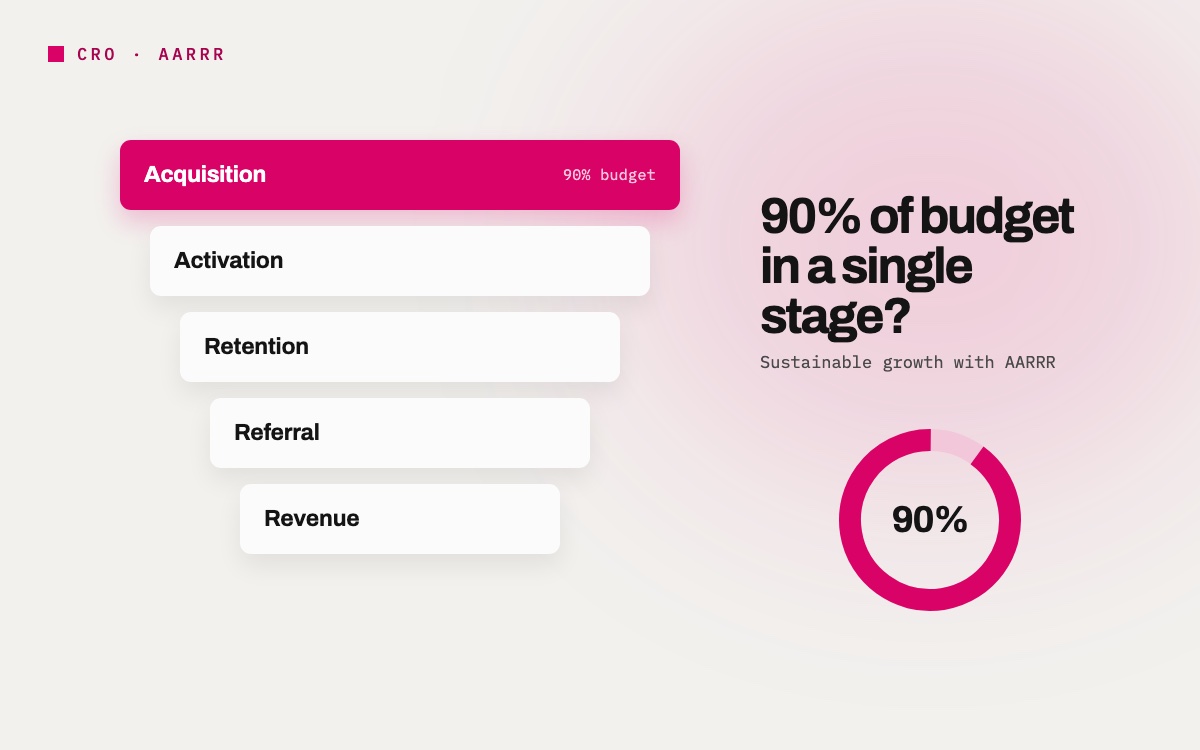
You have a marketing budget of 100 lira. You spend 90 lira of it pulling new customers in through your door. But how many of the customers who walk in actually stay, how many really use your product, and how many recommend you to others? If you don't have a clear answer to these questions, you are probably skipping the most critical steps of the AARRR funnel.
The AARRR (Pirate Metrics) framework, introduced by Dave McClure in 2007, addresses growth in five key stages: Acquisition, Activation, Retention, Revenue and Referral. However, the general trend in the industry is to focus only on the first of these five stages. In this article, let's look at the data to see why this imbalance is a growth trap and why each step matters in its own right.
The Acquisition Obsession: What Does the Data Say?
There is a truth in the marketing world: acquiring new customers is much more expensive than retaining existing ones. According to a study published in Harvard Business Review, the cost of acquiring a new customer is 5 to 25 times higher than the cost of retaining an existing one (Harvard Business Review, 2014). Despite this, the vast majority of brands still allocate the lion's share of their marketing budgets to acquisition channels.
A famous study by Bain & Company is even more striking: an increase of just 5% in customer retention can raise profitability by between 25% and 95% (Reichheld & Schefter, 2000). In other words, the return on investment in the lower layers of the funnel is dramatically higher than in the top layer.
So, with such clear data at hand, why are brands still so dependent on acquisition? Because acquisition is measurable, visible and satisfying in the short term. When you increase your ad spend, traffic goes up, downloads rise and the chart looks like "growth". However, this growth is often an illusion, because most of the arriving users leave without being activated and without forming a real connection with the product.
The "But We're a New Brand" Objection
We must not miss a nuance here. If you are a newly established brand or entering a brand-new market, an acquisition-heavy strategy can make sense for a certain period. Talking about activation or retention before building awareness doesn't make much sense; first, people need to know you and experience you.
The problem is this: this "early-stage" logic continues as the default strategy in mature brands as well. In its early years, Uber used aggressive incentives and promo codes for customer acquisition, which was right for that period. But Uber's real growth leap came when it launched its referral program and optimized the user experience. Uber's "invite a friend, you both get two free rides" program became one of the company's most powerful growth engines.
Even big, well-established brands can fall into this trap. Blue Apron is a striking example: the company made heavy marketing investments in customer acquisition in 2017 ahead of its IPO. However, the retention rate of acquired customers was extremely low. According to ProfitWell's industry analyzes, Blue Apron's customer churn rate was constantly outpacing its acquisition rate. This was cited as one of the main reasons for the dramatic drop in the company's share price within two years of its IPO.
Why Is Every Step of the AARRR Funnel Important?
1. Acquisition: Opening the Door
Acquisition is of course important, but it is not enough on its own. At this stage, the focus should be on attracting the right audience. Instead of the "the more traffic the better" approach, targeting users who truly match the product benefits the entire funnel in the long run. According to HubSpot's 2023 State of Marketing report, 61% of marketers see generating high-quality traffic and leads as their biggest challenge. The point is not just to attract many people; it is to attract the right people.
2. Activation: Creating the "Aha!" Moment
The user has come through the door, but are they actually experiencing the value of your product? Activation is the moment the user has their first meaningful interaction with the product. Slack's growth team discovered a critical threshold in product adoption: a team sending 2,000 messages. Teams that crossed this threshold had a very high rate of becoming long-term users. Slack designed its entire onboarding experience to speed up reaching this "aha!" moment.
If you are not investing in activation, every penny you spend on acquisition is like pouring water into a leaky bucket. The user comes, doesn't understand the product and leaves. This effectively doubles or triples your acquisition cost.
3. Retention: The Real Engine of Growth
Retention is perhaps the most underestimated yet most decisive step of the AARRR funnel. Without retention, sustainable growth is impossible. According to widely cited research by Gartner Group, 80% of a company's future revenue comes from just 20% of its existing customers. Spotify is one of the brands that understands this well: personalized features such as Discover Weekly draw users back to the platform every week and directly increase retention.
4. Revenue: Turning Value into Money
You have acquired, activated and retained the user; now it is time to generate revenue. The revenue stage is not just about "making a sale"; it is about maximizing customer lifetime value (CLV). Amazon's Prime membership model is a perfect example: according to Consumer Intelligence Research Partners (CIRP) data, Amazon Prime members spend an average of $1,400 a year, while non-Prime customers spend about $600. Amazon optimized both metrics at once by building a system that intertwines the retention and revenue stages.
5. Referral: The Most Powerful Growth Channel
Referral sits at the very bottom of the funnel, but its impact feeds the entire funnel. According to global research by Nielsen, 92% of consumers trust recommendations from people they know more than any other form of advertising (Nielsen Global Trust in Advertising, 2021). Dropbox's legendary referral program brought the company 4 million users in 15 months. Moreover, these users had much higher activation and retention rates than those acquired through advertising. Today, Dropbox's growth story is cited as the textbook example of a referral program.
The Real Cost of an Unbalanced Funnel
Let's summarize the concrete results of investing only in the top of the funnel with a table:
According to a comprehensive analysis of the SaaS sector by ProfitWell, companies that invest in retention grow 2-3 times faster than companies focusing only on acquisition. The reason is simple: retention creates compound growth. Every customer you retain each month grows the revenue base for the next month, whereas acquisition starts from scratch every time.
So What Should You Do? A Balanced AARRR Strategy in Practice
The first step is to define separate KPIs for each stage of the funnel. For acquisition, don't just look at traffic and downloads; look at acquisition cost and source-level quality metrics. For activation, define your "aha moment" metric: which action do users take before they become long-term users? For retention, run cohort analyzes and track your 7-day, 30-day and 90-day retention rates. For revenue, monitor your CLV/CAC ratio. For referral, measure Net Promoter Score (NPS) and organic sharing rates.
The second step is to spread the budget across the entire funnel. Each brand's ideal split will differ, but as a general rule, a mature brand allocating 40-50% to acquisition, 30-40% to activation and retention, and 15-25% to revenue optimization and referral programs is a balanced starting point. These shares should be calibrated to the industry, product maturity and current metrics.
Fix the Leaky Bucket to Grow
The AARRR funnel works as a whole. Without acquisition, users don't come; without activation, users don't understand the value; without retention, growth cannot be sustained; without revenue, the business model doesn't work; and without referral, you miss out on the most powerful growth engine.
There is a famous growth hacking saying: "Growth is not about pouring more water into a leaky bucket; it is about fixing the leaks first." If you are spending 90% of your budget on acquisition, you may in fact be filling a leaky bucket. What will really make the difference is treating each step of the funnel with the same seriousness and optimizing the entire user journey.
Sources
- Reichheld, F. & Schefter, P. (2000). "The Economics of E-Loyalty." Harvard Business School Press. (Bain & Company research)
- Harvard Business Review (2014). "The Value of Keeping the Right Customers."
- Nielsen (2021). "Global Trust in Advertising Report."
- HubSpot (2023). "State of Marketing Report."
- Consumer Intelligence Research Partners (CIRP). Amazon Prime member spending data.
- ProfitWell / Paddle. SaaS Retention & Growth Benchmarks.
- Gartner Group. Customer Experience & Retention Statistics.
Let’s talk about this for your brand.
Write to us →