
Escape the Data Chaos: How Do You Set the Right KPIs for Your Company?
Let's look step by step at how to set the right KPIs that will genuinely drive your company's growth.
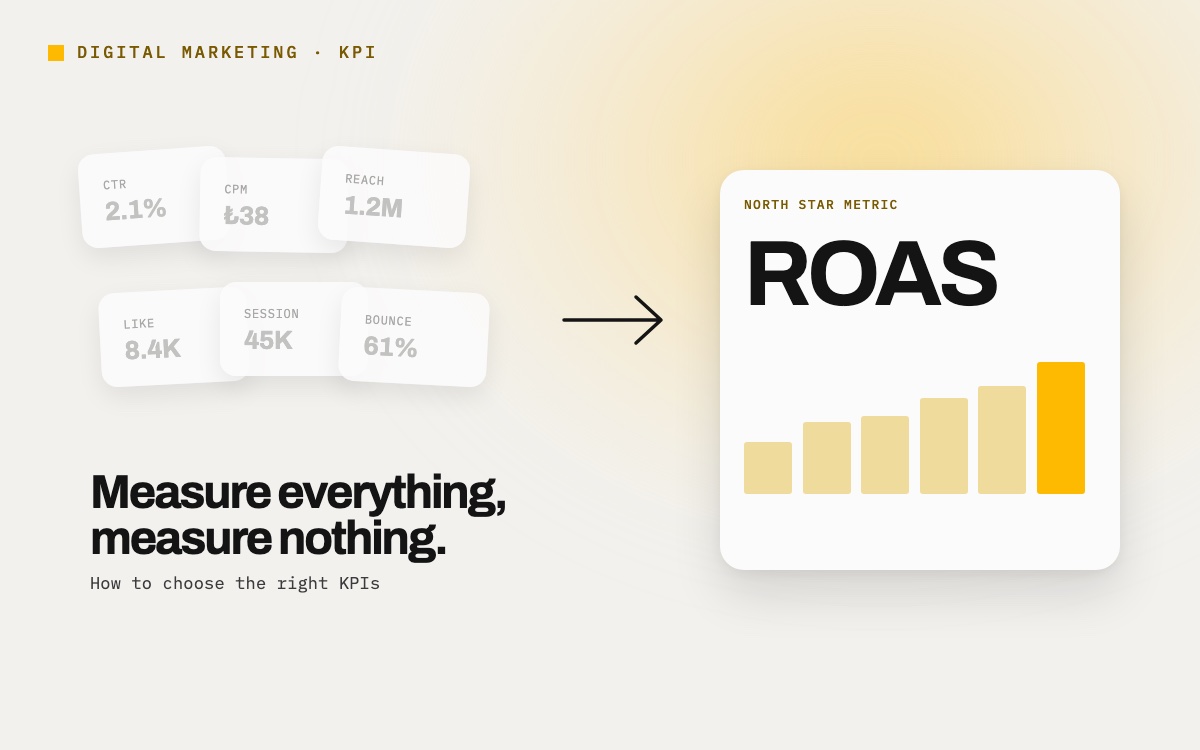
Today we don't suffer from a lack of data; quite the opposite, we are drowning in it. Google Analytics reports, CRM data, social media engagement, hundreds of metrics from ad platforms... When you open your computer every morning, do these charts really show you where your company is heading, or do they just intimidate you?
If you also feel lost among dozens of different reports, you have probably missed the line between a "metric" and a "Key Performance Indicator" (KPI).
Let's put an end to this data chaos and look step by step at how to set the right KPIs that will genuinely drive your company's growth.
1. Metric or KPI? Understanding the Difference
The first step in choosing the right indicators is understanding what is merely a "number" and what is a "compass".
- Metric: Your website's monthly visitors, likes on Instagram or bounce rate are all metrics. They describe the situation, but on their own they don't serve a business goal.
- KPI (Key Performance Indicator): The most critical metrics, which directly affect the success of your business and are tied to your strategic goals. For example, "website traffic" is a metric, whereas "qualified form conversion rate from the website" is a KPI.
Remember: every KPI is a metric, but not every metric is a KPI.
2. A 4-Step Formula for Setting the Right KPIs
When choosing the indicators that are vital for your company, you can follow these steps:
Step 1: Clarify Your Business Goals (Where Are You Heading?)
KPIs don't fall from the sky; they grow out of your business goals. What is your priority this year?
- Entering new markets?
- Increasing your customer retention rate?
- Growing your e-commerce revenue by 40%? If the goal isn't clear, the KPI you measure will be wrong too.
Step 2: Stay Away from Vanity Metrics
It's great when a LinkedIn post gets 10,000 views. But if those views don't turn into money in the till or bring in a new business partner, it's a vanity metric. When designing your KPI dashboard, focus on the numbers that grow your business, not the ones that flatter your ego.
Step 3: Apply the SMART Criteria
Every KPI you choose should have these 5 qualities:
- Specific
- Measurable
- Achievable
- Relevant (to your business)
- Time-bound
Bad example: "Increase sales."
SMART KPI example: "Increase e-commerce sales volume from digital advertising channels by 15% in the coming Q3."
Step 4: Stick to the "Less but Better" Rule
Three to five main KPIs per department or project is ideal. If you try to track 25 different KPIs, you won't be able to focus on any of them. The secret to escaping data chaos is choosing the few vital numbers to focus on.
3. KPI Examples for Different Departments
To give you some ideas, here are some of the right KPI models we often use in the digital world:
Turn Data into a Decision-Making Tool
Setting the right KPIs is like giving your company a powerful lantern to light the way in the dark. Turning down the noise of the numbers and focusing only on the data that powers your business's growth engine both protects your budget and directs your team's energy to the right place.
If you're not sure which data to focus on across your company's website, ad campaigns or conversion processes, let's make sense of your data together.
Let’s talk about this for your brand.
Write to us →