
What Are Instagram Deal Accounts? How They Work, Their Advantages and Disadvantages
How exactly do Instagram deal accounts work, how do they differ from classic influencer collaborations and which campaigns are they best suited to?
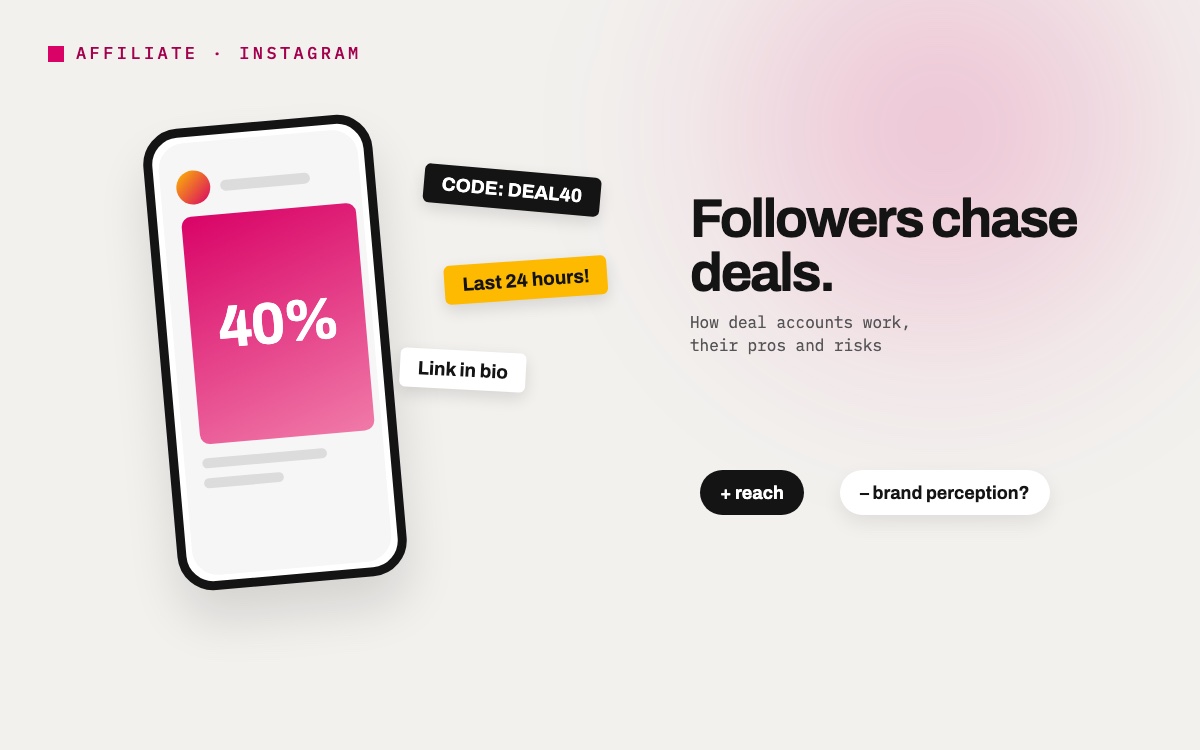
As social media marketing evolves, the ways brands reach users keep changing and developing. In recent years, Instagram deal accounts in particular have become an important way to spread campaigns and offers quickly. These accounts carry brands’ discounts to large audiences, helping to build brand visibility and sales-driven traffic.
How exactly do Instagram deal accounts work, how do they differ from classic influencer collaborations and which campaigns are they best suited to?
What Are Instagram Deal Accounts?
Instagram deal accounts share brands’ campaigns, discount codes and offers. They usually have purchase-minded followers and produce campaign-focused content. They put discounts front and center to speed up users’ purchase decisions.
These accounts:
- Share coupon codes
- Direct traffic through campaign links
- List current deals
- Encourage their followers to buy
They generally work with three different models:
1. Affiliate (Commission-Based Model)
- The account shares a brand-specific discount code or link
- If a user shops with this code, the account earns a commission on the sale
- It is performance-driven (CPA model)
2. Fixed-Fee Posts
- The brand works with deal accounts for a set fee
- Stories, posts or Reels are published
- As with the affiliate model, performance can be measured through posts with UTM parameters.
- This is the most widely used model.
3. Hybrid Model
- A fixed fee and the affiliate (commission) model are used together.
Advantages
Fast and easy reach
- Speaks to a very large, campaign-minded audience
- Can generate high traffic in a short time
An audience ready to buy
- Followers are usually users “looking for a deal”
- The conversion rate can be higher than with campaign-based influencer work
The option to work on a performance basis
- Easy to measure thanks to the CPA model
- Efficient for sales-focused campaigns
Campaign reach
- Instead of a single piece of content, a campaign can spread across many deal accounts
- It has the potential to create a viral effect
The option to work with smaller budgets
- Campaigns can usually be run with more accessible budgets than influencer collaborations.
- Especially for small and mid-sized brands, it offers a chance to reach many people at low cost.
- Affiliate or fixed-fee models allow flexible budget planning.
Disadvantages
Weak control over brand perception
- The content format is usually standard
- Telling the brand’s story can be difficult
- It can be risky for a premium brand image
An audience driven by deals, not loyalty
- Followers are attached to the discount, not the brand
- Traffic drops when the campaign ends
Content quality may be limited
- The content format is mostly set by the account, and brand creatives are only reflected to a limited extent.
- Brand storytelling stays weak
Intense competition and divided attention
- Many brands are posted at the same time
- It becomes harder to catch the user’s attention
Which campaigns are they suitable for?
Deal accounts are especially efficient in the following scenarios:
Discount / campaign periods
Ideal for Black Friday, end-of-season sales and special-day campaigns.
Outlet and clearance sales
They deliver strong performance when stock needs to be cleared quickly.
FMCG / e-commerce products
In highly price-sensitive categories, they push users to act quickly.
Performance-driven campaigns
Used in affiliate work to achieve measurable sales. Campaign-level posts with UTM parameters make it possible to track the standout, high-engagement campaigns.
New customer acquisition
An effective way to encourage a first purchase with discount codes. Ideal for attracting new users.
Which campaigns are they not suitable for?
Premium and luxury brand campaigns
For high-end brands, brand perception and prestige matter a great deal. The deal-driven nature of these accounts can weaken that perception and clash with the brand’s positioning.
Branding and brand-story campaigns
If the goal is to tell the brand’s story, build an emotional bond and shape brand identity, deal accounts fall short. In these campaigns, storytelling and creative content take priority.
When long-term brand awareness is the goal
If the goal is to increase the brand’s recognition over the long term, stay top of mind and build a strong brand perception, deal accounts alone are not enough. Because they mostly work for short-term traffic and sales, they are weak at building brand awareness.
In these cases, micro/macro influencer collaborations are the better choice.
How They Differ from Influencer Collaborations
Instagram deal accounts and influencer collaborations may look similar, but they represent two separate approaches serving different marketing goals. Deal accounts focus more on campaign and sales performance, while influencer collaborations are built on brand perception, trust and long-term communication. As a result, the content tone, audience structure and results also differ.
Instagram deal accounts are a powerful marketing tool, especially for sales-focused campaigns. Thanks to fast reach, performance measurement and strong conversion, they are often chosen in e-commerce and during campaign periods. However, if brand image, creative content and long-term loyalty are the goals, a hybrid strategy combined with influencer collaborations can deliver more efficient results.
Let’s talk about this for your brand.
Write to us →