Are You Ready for November? A Complete Guide to 11.11, Black Friday and Cyber Monday
November is the busiest month of the year for e-commerce. Competition rises, ad costs climb and users grow less patient. A roadmap for preparing for November, from last year's data and best-performing creatives to campaign comparisons and the logic behind each shopping day.
When November arrives, almost every brand takes the stage at the same time. Discount campaigns, email newsletters, push notifications and ads all compete on the same user's screen. The way to stand out in this crowd is not to shout louder but to prepare better. At Ad Venture Digital, we start preparing for November with our brands months in advance every year. In this guide, we explain step by step what November's shopping days mean, how to read last year's data and how to speed up your preparation with Ad Venture One.
November's shopping days and why they exist
- 11.11 – Singles' Day: Born in China as a celebration of being single, the day became one of the world's biggest online shopping days after Alibaba turned it into a sales event in 2009. In Turkey too, marketplaces and e-commerce sites use 11.11 to open the November sales season. The goal: open the season early and claim the first share of the shopper's budget.
- Black Friday: The Friday after Thanksgiving in the US traditionally marks the start of the holiday shopping season. In 2026 it falls on 27 November. In Turkey, under names such as “Efsane Cuma” (Legendary Friday) and “Muhteşem Kasım” (Magnificent November), it often stretches beyond a single day to a week or even the whole month. The goal: high-volume sales on the year's strongest perception of discounts.
- Cyber Monday: The Monday after Black Friday; 30 November in 2026. It originally grew out of the idea that “shoppers who visited stores over the weekend return to online shopping on Monday”. Today it is used especially for electronics and online-only deals. The goal: win back those who missed Black Friday and those who left products in their basket with a second chance.
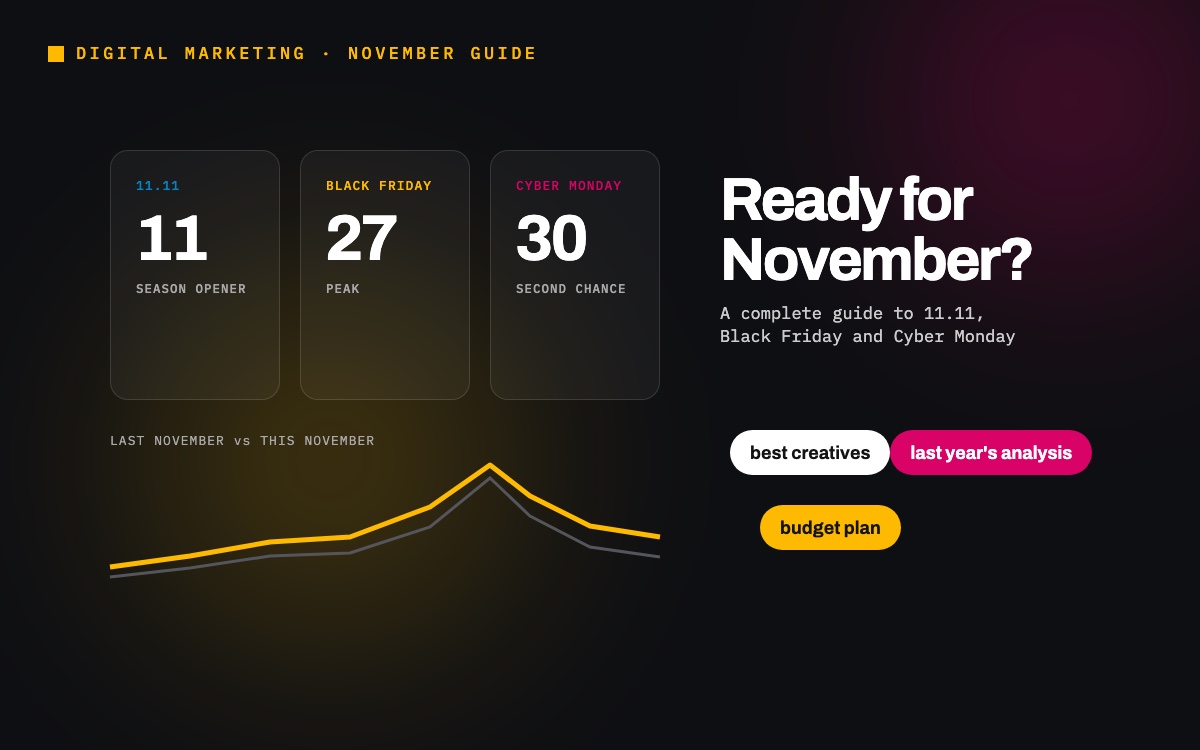
These three days fall in the same month but don't call for the same strategy. 11.11 opens the season and sets price perception; Black Friday is the peak, with the highest competition and the highest conversion potential; Cyber Monday is an opportunity for remarketing and basket completion.
Competition: why does everything get more expensive in November?
In November, more brands enter the ad auction and more brands bid for the same user. The natural result is higher impression and click costs. In this period your goal should be “profitable sales”, not “cheap traffic”. On high-cost days, what pays off is appearing to the right audience, with the right offer, at the right moment. That is why most November preparation happens before November: warming up audiences, testing creatives and validating measurement.
1. Analyze last year honestly
Your most valuable preparation resource is your own history. Look back at last November and seek answers to these questions:
- On which days did sales peak, and on which days did costs rise faster than sales?
- When did you launch the campaign? Was starting early or leaving it to the last day more profitable?
- Did your budget run out on peak days? If not, was an opportunity missed; if so, did it run out during the most profitable hours?
- Were sales lost because of stock, shipping or site speed?
- Which audiences, channels and product groups performed above expectations, and which below?
Repeat what you did right, list what went wrong and write each into this year's plan as a concrete item. Knowing that “last year the budget ran out at 14:00” sets this year's budget pacing rule.
2. Identify your best-performing creatives
Testing new creatives in November is expensive, because the learning period coincides with the highest-cost days. Instead, test throughout October and enter November with proven creatives. Looking at creative performance from last year and recent months, identify:
- Which creatives delivered clearly above average,
- Which worked well for a while and then fatigued,
- Which formats (vertical video, carousel, product image) stood out in which placement.
Prepare November versions of the winning creatives: same concept, new campaign message. This way you use a proven creative structure while updating the message.
3. Compare campaigns and analyze returns
Throughout November, monitor campaigns comparatively rather than one by one. Put this year's campaign side by side with the same period last year, Black Friday week with the week before, and Meta with Google and TikTok. The critical point is how ratios are calculated: averaging daily ROAS figures is misleading; ROAS calculated from the period's total revenue and total spend gives the real picture.
4. Operational preparation for Black Friday
Stress testing the site infrastructure, getting landing pages indexed in advance, a time-based budget plan for the period when CPMs rise, segmentation, email and SMS automations, up-to-date product feeds and a post-Black Friday retention plan… Each of these is an essential part of November success. Our colleague Cavide Pala covered these steps one by one in Getting Ready for Black Friday: 10 Strategic Steps for Brands; we recommend reading this guide alongside it. Here we focus on the month as a whole and on how to read the data.
5. Plan the month as three acts, not as a single day
Running 11.11, Black Friday and Cyber Monday as copies of the same campaign lowers the month's potential. On 11.11, messages that open the season and warm up the audience; in Black Friday week, the strongest offer and the most proven creatives; on Cyber Monday, remarketing to basket abandoners and those who missed the campaign should take the lead. Measure the success of each act separately, because each has a different goal.
How to prepare for November with Ad Venture One
Ad Venture One is the platform Ad Venture Digital developed for its brands, bringing Meta, Google, TikTok, Yandex, Adjust and GA4 data together on one screen. It speeds up your work at almost every step of November preparation:
- Comparison with last year: On the ROAS comparison screen you can put any day side by side with the previous day, week, month or last year, and see within minutes where last November was strong and where it was weak.
- Campaign comparison: Compares each campaign's spend, revenue and ROAS in your chosen period with the previous period of equal length, showing Meta, Google and TikTok in the same table.
- Creative Performance: Compares each creative with the account average and sorts them into scale, fatigued, watch and review buckets. You choose which creatives to enter November with based on data; recoverable budget also shows the spend going to weak creatives.
- Hourly spend and anomaly monitoring: On peak days you can track at what hour and how fast the budget is being spent, and spot unexpected drops and spikes immediately.
- Autopilot: Produces recommendations every day, such as shifting budget to winning creatives, pausing weak ones and updating budgets. Every change is prepared as a draft and is not applied without expert approval; what was recommended, and what was held back and why, is visible in the decision log.
November may look like a sprint, but it is really the final stretch of a marathon. Brands that prepare in October sell more at lower cost in November. If you'd like Ad Venture Digital to draw up a November plan for your brand, we can start by looking at last year's data together.
Let’s talk about this for your brand.
Write to us →