
Milliseconds Cost Millions: A Roadmap for the Site Speed–Conversion Link in Light of the Google/Deloitte Speed Study
According to research Deloitte conducted for Google, speeding up your mobile site by just this much lifts retail conversion by more than eight percent. The blink of an eye; millions in revenue.
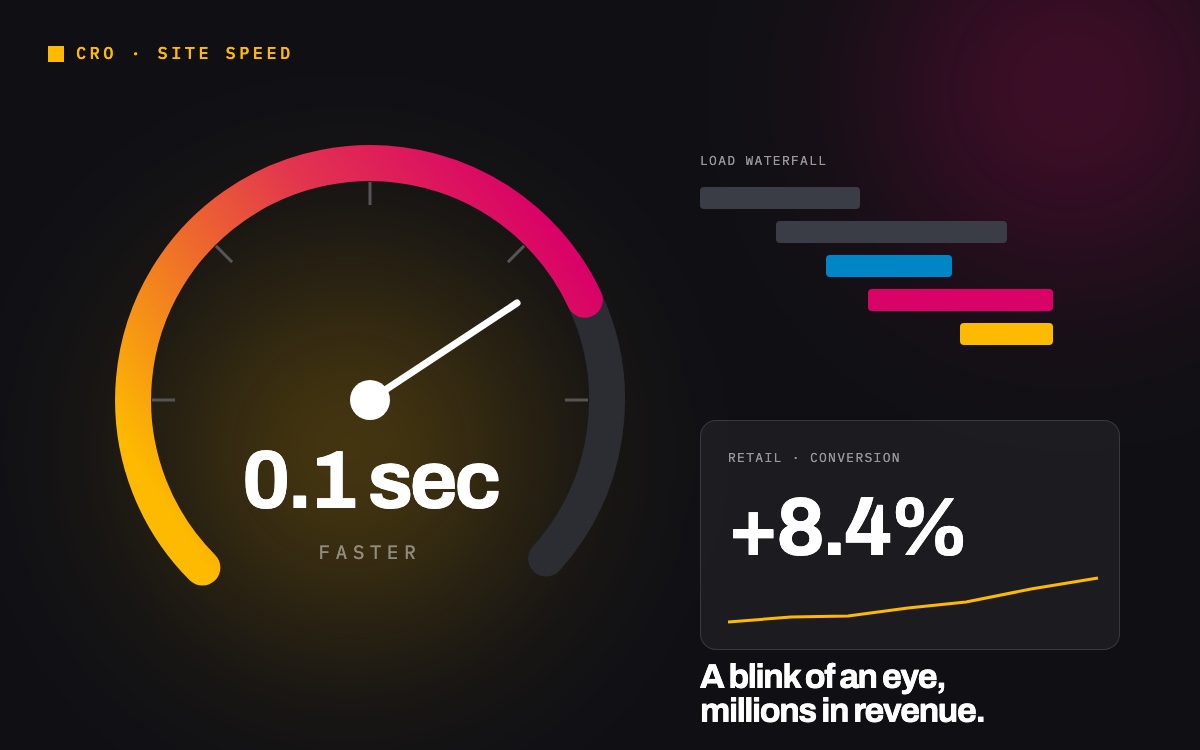
Blink once. That's it. Around a hundred milliseconds. According to research Deloitte conducted for Google, speeding up your mobile site by just this much lifts retail conversion by more than eight percent. The blink of an eye; millions in revenue.
So if this much money is lying on the table... why is site speed still IT's chore in most companies? Because nobody looks at it as a revenue line. In this article, we make you look at it that way.
FRAMEWORK: A Three-Link Chain of Evidence and the Mechanism
First, the chain of evidence: three links, all three etched into history.
- Link one, an anecdote from the inside: the finding Amazon engineers shared in the mid-2000s was that every hundred milliseconds of latency cost roughly one percent of sales.
- Link two, behavior: Google's now-classic mobile study showed that more than half of visits are abandoned when a page takes longer than three seconds to load.
- Link three, and the subject of this article: the 2020 study Deloitte ran for Google across thirty-seven leading brands, called, quite literally, "Milliseconds Make Millions". The intervention was tiny: a one-tenth-of-a-second improvement in mobile speed.
Results by vertical: in retail, conversion rose by 8.4% and average order value by 9.2%; in travel, conversion rose by 10.1%.
So what is the mechanism, and why is the link so sensitive? Three reasons, all three rooted in human nature.
- One: Waiting is a cognitive cost. Every delay is an invitation to leave.
- Two: Slowness is a trust signal; a page that stalls at checkout in particular reads like a page that "doesn't work"
- Three: The tax compounds. The speed penalty applies per page; a five-step funnel multiplies it by five. And a note: your site is not as fast as your office computer, but as fast as your customer's mid-range phone on that day's network.
CASE ANALYSIS: Pinterest's Decision, 2017
A documented example of how these principles turn into revenue in the field is Pinterest's 2017 mobile web move. The company saw that its slow mobile site was choking growth, and the critical decision was organizational, not technical: the work was handed not to IT as a maintenance item, but to the Growth team as a growth feature.
Pages were rebuilt around the critical path: content visible on screen first, the rest after; the payload was slimmed down. According to the results shared on their engineering blog, perceived wait time fell by 40%. In return, sign-up conversion rose by 15% and search engine traffic by 15%.
The real lesson of the case is not the numbers but ownership: when the owner of speed changed, the nature of speed changed too. From chore to revenue feature.
A FOUR-STEP ROADMAP
Step one: Measure with real users, not in the lab. There are two kinds of speed data, and they do different jobs. Lab measurement is a diagnostic tool. Field data is the referee; decisions are made on field data. Second rule: averages lie. Your average can look fine while a quarter of your users are suffering, so measure the slow segment. Third rule: break it down. Not the home page, but product, cart and checkout. Not the desktop average, but mid-range mobile.
Step two: Turn speed into money with your own data. Do in your own funnel what Deloitte did: segment users by the load speed they experienced into fast, medium and slow cohorts, and put each segment's conversion rate side by side. What you get is your own speed–conversion curve. Multiply the curve by your traffic distribution and you have the annual bill for slowness, and that single table is the business case for speed investment on the CFO's floor.
Step three: Slim down the critical path, not the whole site. A "let's speed up the whole site" project dies; a "let's speed up the checkout path" project gets finished. First map the conversion path (product, cart, checkout) and slim it down with three lasting principles. Load less: every third-party script and every huge image on the page is a tax; take an inventory and apply the technical twin of the form test in section four: "Does this load serve conversion?" If not, it goes. Load what's visible first: main content to the screen, the rest in the background. Don't make people reload: what has been downloaded once should come from the cache. In e-commerce the most common tax is images, so look at weight there first.
Step four: Make speed a budget, not a project. Speed isn't won once; it is defended. Every new campaign script, every pop-up, every tool integration is speed debt; without a budget, the gains are gone within three months. Lasting practices: define a threshold per page type, and anything that would push past it comes to the table. Make a speed check routine before anything goes live. And ownership, the Pinterest lesson: speed belongs not to IT, but to revenue.
VERTICAL BREAKDOWN
In e-commerce, speed is the technical foundation of the trust layer in section four; slowness at checkout is the quietest form of distrust, and image weight is the first suspect.
In lead gen and SaaS, if most traffic comes from ads, there is a second bill: ad platforms factor the landing experience into pricing. The names of the mechanisms change; the principle has been the same for ten years: a slow page means an expensive click.
Speed is not an IT chore; it is a revenue line.
Let’s talk about this for your brand.
Write to us →