
Measuring the Invisible: Copy Tracking with GTM and GA4 Integration
Go beyond standard metrics. Track the text users copy on your e-commerce site with Google Tag Manager and GA4, and analyze user intent and UX issues.
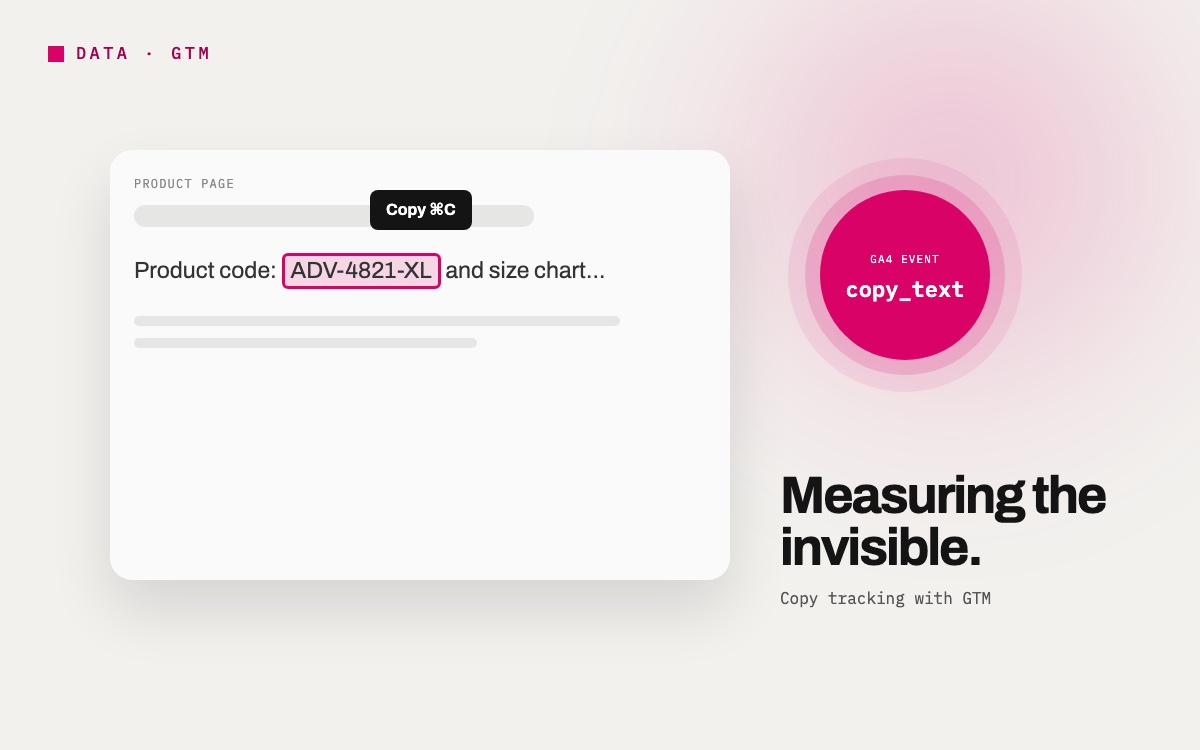
For years, e-commerce analytics has relied on similar metrics: page views, clicks, add-to-cart rate and conversion rate. These metrics are certainly critical. But they are often not enough to fully understand how users make purchase decisions. Because some of the most important signals of user behavior are never measured in standard analytics setups.
One of these signals is which text users copy on the website.
When a user copies a piece of text, it usually means that information matters to them. They may want to share it elsewhere, compare it, save it or use it later. This behavior is an extremely valuable data point for understanding purchase intent.
What Do Users Copy on E-Commerce Sites?
Analyses of e-commerce sites show that users most often copy the following content:
- Product names
- Model codes and SKU information
- Technical specifications
- Price information
- Campaign and coupon codes
- Specific phrases in product descriptions
These behaviors show that the user is at an important stage of the purchase funnel. But you cannot see this behavior in a default Google Analytics setup…
How Did We Solve This Problem?
To measure this behavior, we built a custom event implementation in Google Tag Manager.
We set up a mechanism that listens for the “copy” action in the browser. When a user copies text, we capture the selected text and send it to Google Analytics.
With this integration, we can analyze not only the copy action itself, but also on which page, for which product and with which content it happened.
The implementation was designed to be managed entirely through Google Tag Manager and integrated seamlessly into the existing analytics infrastructure.
Types of Insight We Gained
After this tracking implementation, we started gaining many valuable insights we previously had no access to.
1. Identifying the Most Researched Products
We observed that some products were copied very often even though their sales were not high. This shows that users are actively researching these products but may still be at the decision stage.
This insight creates an important opportunity for remarketing and campaign strategies.
2. Identifying Critical Product Information
The content users copy most often is usually the information that matters most in the decision process.
For example:
- Model number
- Capacity
- Compatibility
This shows which information should be more visible on the product page.
3. Detecting UX Problems
Sometimes users copy information simply because it is hard to find.
If a particular piece of information is copied constantly, it may mean that:
- The user has to keep it for reference
- The information is not visible enough
- Or the user thinks they won't be able to find it again later
This insight leads directly to action on UX improvements.
4. Campaign and Coupon Usage Behavior
The rate at which coupon codes are copied is a strong metric for understanding real intent to use a campaign.
With this data, you can understand:
- Which campaigns genuinely attract interest
- Which campaigns are being ignored.
5. Content and SEO Strategy
Copied text reveals the content users find most valuable.
This content can be:
- Made more visible
- Turned into separate landing pages
- Prioritised in your SEO strategy.
The Advantage of GA4's Event-Based Model
The event-based data model of Google Analytics 4 provides great flexibility for measuring custom user interactions like these.
Going beyond standard events, you can measure behaviors specific to your business model.
This way, the analytics system stops being just a reporting tool and becomes a decision support system.
Privacy and Security
User privacy is critical in implementations like this.
That is why, during implementation:
- fields containing personal data can be excluded
- Text length can be limited
- Specific pages can be excluded.
The goal is to understand behavior patterns, not the individual user. ——
Modern e-commerce analytics cannot rely on click and view data alone. Understanding users' micro-behaviors reveals their real intent.
Thanks to the copy tracking implementation, we can now answer these questions with data:
- Which products are genuinely being researched?
- Which information plays a critical role in the purchase decision?
- Which campaigns influence user behavior?
- Which product pages should be optimized?
Thanks to the flexible structure of Google Tag Manager and GA4, advanced tracking scenarios like this can easily be integrated into existing infrastructure.
The right data is the foundation of the right decisions. Understanding not just what users click, but what they care about, is what makes the real difference.
Let’s talk about this for your brand.
Write to us →