
What Is ROAS? How to Calculate It and What a Good ROAS Is: A Target ROAS Guide
ROAS tells you how much revenue every unit of ad spend brings back. It looks like a simple ratio, but the answer to “what should it be” differs for every business. In this guide we explain how ROAS is calculated, how to find your own break-even point, why ad platforms report different ROAS figures and how to use target ROAS bidding.
When you open an ad account, ROAS is probably one of the first numbers you look at. And “ROAS came in at 4, is that good?” gets asked in almost every meeting. The answer starts with knowing what ROAS measures and what it does not. Below you will find the definition and the calculation first, then the right answer to “what should it be”, and finally practical ways to improve it.
What is ROAS?
ROAS stands for Return on Ad Spend. It shows how much revenue an advertising campaign generates for every unit of budget spent on it.
ROAS is a ratio. It is usually written as “4” or “4x”; some interfaces show the same value as a percentage, “400%”. Both say the same thing: every 1 spent on ads brought back 4 in revenue.
How to calculate ROAS
The formula is a single line:
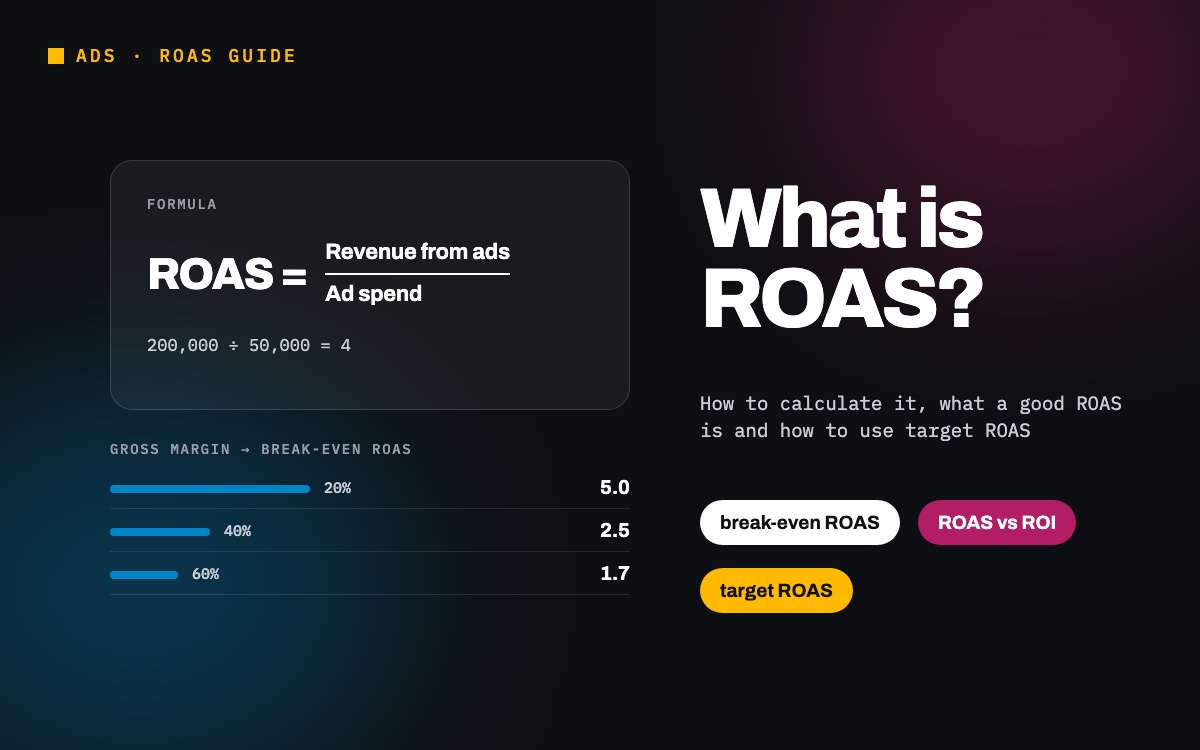
ROAS = Revenue from ads ÷ Ad spend
Example: in one month you spent 50,000 on ads and the sales attributed to those ads brought 200,000 in revenue. ROAS = 200,000 ÷ 50,000 = 4.
Watch three things when you calculate it:
- Use the same period. Revenue and spend must cover the same days. Taking spend from one month and revenue from another window quietly distorts the ratio.
- Do not average daily ratios. A week’s ROAS is not the average of seven daily ROAS figures; it is the week’s total revenue divided by total spend. A low-spend day with a high ratio pulls the average up misleadingly.
- Fix the definition of revenue. With or without VAT, net of returns or not, shipping included or not: whichever you choose, use the same one in every report.
ROAS vs ROI
The two are often confused, but they answer different questions:
- ROAS looks only at ad spend and measures revenue. It answers “how much did the ads sell?”
- ROI (return on investment) looks at total cost and measures profit: product cost, shipping, returns, agency and staff costs included. It answers “did we make money?”
That is why a high ROAS does not necessarily mean a profitable campaign. On a low-margin product a ROAS of 4 can lose money; on a high-margin product even a ROAS of 2 can be profitable. This is exactly where the answer to “what should it be” lies.
What is a good ROAS? Calculating break-even ROAS
There is no “good ROAS” that fits everyone. The right question is: below which ROAS do I lose money? That value is your break-even ROAS, and it comes from your gross margin:
Break-even ROAS = 1 ÷ Gross margin
Gross margin is the share left from the selling price after product cost (and, if you like, variable per-order costs such as shipping and payment fees), divided by the selling price. With a 40% margin, break-even ROAS is 1 ÷ 0.40 = 2.5. Any ROAS below 2.5 means you are not earning back your ad spend.
| Gross margin | Break-even ROAS |
|---|---|
| 20% | 5.0 |
| 30% | 3.3 |
| 40% | 2.5 |
| 50% | 2.0 |
| 60% | 1.7 |
Your target ROAS should sit above break-even. How far above depends on your business goal:
- Profit first: the target is kept clearly above break-even, and budget goes only to campaigns that clear it.
- Growth first: to win new customers, a ROAS close to break-even, or even briefly below it, can be accepted on purpose. For that decision to be sound you need to know how much a customer buys over time (lifetime value).
- Seasons and sales: discounts lower your margin, so break-even ROAS rises. Recalculate the target whenever you change the discount rate.
Why do platforms report different ROAS?
For the same period, Google Ads, Meta Ads Manager and Google Analytics 4 usually show three different ROAS figures. That is not an error; it is a difference in measurement models:
- Attribution model: each platform tends to credit the sale to its own ads. If a user first sees an Instagram ad and later buys after a Google search, both platforms may claim the same sale.
- View-through attribution: Meta also counts users who saw an ad without clicking and bought later. GA4 only sees the session that reached the site.
- Attribution window: how many days after a click a sale still counts varies by platform.
- App versus web: in-app purchases show up in mobile measurement tools, web purchases in GA4; without combining the two, total ROAS is under-read.
Practical advice: read the ROAS you make decisions on from a single source with a consistent definition, and compare platform screens against it. To understand the gap between platforms, see our article on standard versus incremental attribution.
How does target ROAS (tROAS) bidding work?
When you add a target ROAS to the “Maximise conversion value” strategy in Google Ads, the system bids in every auction to reach the ratio you set. In Meta, the minimum ROAS goal does a similar job. To get good results from these strategies:
- Have enough conversion volume. Smart bidding learns from past conversions. In a campaign with only a few conversions a month, target ROAS forces the system to guess with little data; starting with a strategy that grows conversion volume first is healthier.
- Derive the target from what you measure. Use the campaign’s actual ROAS over the last few weeks as the starting point. A target far above today’s value makes the campaign stop entering auctions and spend drops.
- Change it in small steps. Changing the target sharply all at once disrupts learning. Move gradually and watch results for a few days after each step.
- Send conversion values correctly. Target ROAS is only as good as the value you send. If a fixed value is sent instead of the order amount, or some sales are not sent at all, the strategy optimises the wrong thing.
Common mistakes that lower ROAS (or misreport it)
- Mixing brand searches with performance campaigns: searches for your brand name come from users already close to buying and produce very high ROAS. Pooled with other campaigns, they make overall ROAS look good and hide the weakness of campaigns that bring new customers.
- Incomplete conversion tracking: if the purchase tag does not fire for some payment methods or in the app, revenue looks lower and so does ROAS.
- Ignoring returns: in categories with high return rates, platform ROAS looks better than reality.
- Looking at too short a window: a one- or two-day ROAS, especially in low-volume campaigns, is mostly noise. For decisions, use the total of at least a week, preferably longer.
- Trusting a single average: the account average may look healthy while some campaigns, ad sets or creatives spend budget at a loss.
How to improve ROAS
- Shift budget to winners. At campaign, ad group and creative level, move budget from those below break-even to those above it.
- Cut wasted spend. In search campaigns, add non-converting search terms as negative keywords; in social campaigns, pause weak placements and creatives.
- Refresh creative. Creatives that run for a long time wear out; click-through and conversion rates fall. Test new variations in their place.
- Improve site conversion rate. ROAS is not only about ads: page speed, product pages and checkout shape the result. If a larger share of the same traffic buys, ROAS rises on its own.
- Grow order value. Bundles, free-shipping thresholds and complementary product suggestions bring more revenue for the same ad spend.
- Refine audiences. Audiences built from first-party data, such as customer lists and site visitors, usually deliver higher ROAS; manage them separately from new-customer campaigns.
Is ROAS enough on its own?
No. ROAS is a good starting point for understanding a campaign’s efficiency, but it does not show the whole picture. For a sound assessment, put these next to it:
- Overall marketing efficiency: total revenue across all channels divided by total marketing spend. It is not affected by platforms claiming each other’s sales.
- New-customer share and cost per new customer: growth comes from new customers, not from selling again to existing ones.
- Customer lifetime value: a channel with low first-order ROAS can be the most profitable in the long run if it brings customers who buy again.
- Incrementality: “would this sale have happened without the ad?” Controlled tests with a holdout group are the most reliable answer.
To decide which metrics fit your business, read our article on choosing the right KPIs.
What does good ROAS management look like?
In a well-run account, ROAS is used as a decision tool, not as a goal in itself. Break-even is calculated from margin; the target is set against it and against the business priority; revenue is measured with one definition and platform screens are compared with it; and budget moves to winners every week based on evidence. Above all, why a change moved ROAS can be explained. If your ad account cannot give you clear answers to these questions, we can look at it together on the performance marketing side.
Frequently asked questions
- What is a good ROAS?
- There is no single value for everyone. First calculate your break-even ROAS: 1 ÷ gross margin. With a 40% margin, break-even ROAS is 2.5. Your target ROAS should be above that; how far above depends on whether you prioritise profit or growth.
- How is ROAS calculated?
- ROAS is revenue from ads divided by ad spend. If 50,000 in spend brought 200,000 in revenue, ROAS is 4. Revenue and spend must cover the same period, and ROAS over several days must be calculated from totals.
- What is the difference between ROAS and ROI?
- ROAS measures revenue against ad spend only. ROI measures profit against total cost, including product cost, shipping, returns and other expenses. A high ROAS does not always mean a profitable campaign.
- Is ROAS written as a percentage?
- Both forms are used. A ROAS of 4 and a ROAS of 400% mean the same thing: every 1 spent on ads brought back 4 in revenue.
- When should you use target ROAS bidding?
- When the campaign gets conversions regularly and conversion values are sent correctly. In low-volume campaigns it is healthier to start with a strategy that grows conversions and to derive the target from the campaign’s measured ROAS.
Let’s talk about your ROAS targets.
Write to us →