
What Is CPA? How to Calculate It and How CPA, CPL, CPI and CAC Differ
CPA tells you what each result you win through ads costs you: a sale, a sign-up, an app install. But when the definition of “result” changes, so does the number; that is why CPL, CPI and CAC are separate metrics. In this guide we explain how CPA is calculated, how it differs from similar metrics, how to set a target CPA and practical ways to bring it down.
CPA is one of the most common abbreviations in ad reports. For an e-commerce manager it can mean cost per sale, for a school cost per application, for an app cost per install. The same letters measure a different result in different businesses. So reading CPA correctly starts with being clear about what you mean by “result”.
Note: CPA in accounting (Certified Public Accountant) is not the subject of this article. Here we cover CPA in digital advertising.
What is CPA?
CPA stands for Cost per Acquisition (sometimes Cost per Action). It shows how much you spend on average to obtain a defined result (a conversion) in an ad campaign.
A conversion is the action you define for your business: a purchase, a form submission, a sign-up, a trial start, an appointment, an app install. The value of CPA depends on that definition; “our CPA is 150” says nothing until you say which conversion is counted.
How to calculate CPA
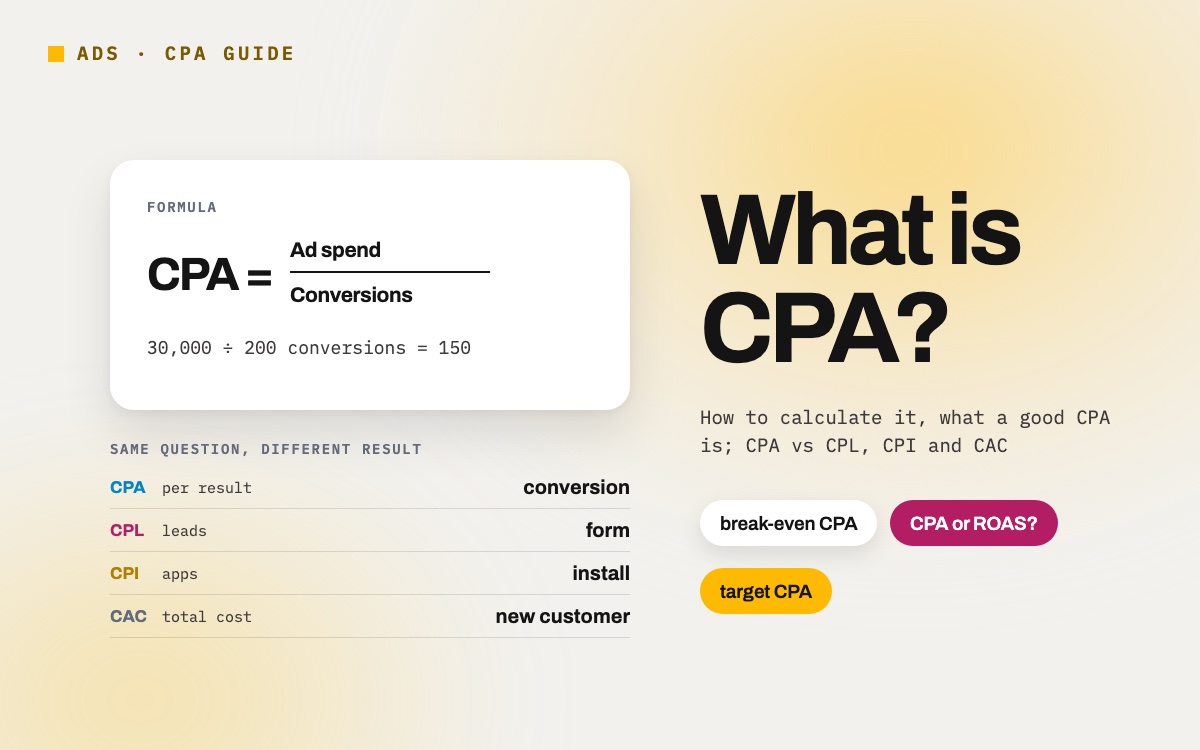
CPA = Ad spend ÷ Number of conversions
Example: in one month you spent 30,000 on ads and received 200 form submissions. CPA = 30,000 ÷ 200 = 150.
Things to watch:
- Same period: spend and conversions must cover the same days.
- Calculate from totals: the CPA of several days or campaigns is total spend divided by total conversions, not the average of daily CPAs.
- Zero conversions means “no result yet”, not “infinitely expensive”. But if spend continues and no conversions arrive, CPA is at least the amount spent; ignoring this hides expensive campaigns.
- One conversion definition: if purchases and add-to-carts are summed in the same column, CPA looks cheaper than it is.
CPA vs CPL, CPI and CAC
All of these answer “what does a result cost?”; the difference is in which result is counted and what is included in the cost.
| Metric | Formula | Used in |
|---|---|---|
| CPA Cost per Acquisition | Spend ÷ conversions | General; sales, sign-ups, appointments |
| CPL Cost per Lead | Spend ÷ leads (forms, calls) | Education, health, B2B, real estate |
| CPI Cost per Install | Spend ÷ app installs | Mobile apps |
| CAC Customer Acquisition Cost | Total marketing and sales cost ÷ new customers | Business-level profitability |
- CPL measures an intermediate step: someone who fills in a form is not yet a customer. Always track the share of qualified leads and of leads that turn into sales next to CPL; cheap leads that never convert end up expensive.
- CPI is also an intermediate step: a user who installs may never open the app or subscribe. For apps it is healthier to decide based on post-install events (registration, purchase, subscription).
- CAC is the broadest: it includes not only ad spend but also agency, tools, team and discount costs, and counts only new customers. It is used for the company’s growth model, not for an ad campaign.
As a rule: use CPA, CPL or CPI for campaign decisions, and CAC together with customer lifetime value (LTV) for the sustainability of the business model.
CPA or ROAS?
Both look at the same data from different angles. If order value varies a lot between orders, ROAS gives a more accurate picture: a 100 sale and a 5,000 sale affect CPA equally but do not contribute equally to your business. If every conversion is worth roughly the same (an application, a sign-up, an install), or revenue cannot be sent to the ad platform, CPA is more practical. We explain how to read ROAS in e-commerce in our ROAS guide.
What is a good CPA? Setting a target CPA
A “good CPA” varies by sector, product and margin; comparing with another brand’s CPA is usually misleading. You can find your own limit like this:
Break-even CPA = Average order value × Gross margin
If your average order is 800 and your gross margin is 35%, each order leaves 280 before advertising. If CPA is above 280, you lose money on the first order.
- If customers buy again: losing money on the first order can be a deliberate choice. If a customer orders three times a year on average, you can set the limit against that period’s total contribution rather than the first order. That requires measuring customer lifetime value.
- In lead-generation businesses: build the target CPL backwards from the sale. If one sale leaves you 20,000 and 5% of leads become sales, you can pay at most 1,000 per lead.
- For apps: derive the target CPI from the share of installers who pay and the average revenue per paying user.
Target CPA bidding
When you add a target CPA to the “Maximise conversions” strategy in Google Ads, the system bids while trying to keep the average conversion cost around that value. In Meta, the cost cap does a similar job. For healthy results:
- Build up enough data first. Smart bidding learns from past conversions; in a campaign with only a few conversions a month, a target CPA ties the system’s hands.
- Start the target from what you measure. Use the campaign’s actual CPA over recent weeks as the starting point. A target far below today’s value makes the campaign stop entering auctions and delivery drops.
- Change it gradually. Lowering or raising the target sharply disrupts learning; move in small steps.
- Optimise for the right conversion. The campaign bids for whatever it counts as the “primary” conversion. If old, broken or unimportant actions sit in the primary list, the system optimises for the wrong goal.
When CPA misleads
- Double counting: if the same purchase is counted both by the site tag and by an imported Analytics goal, conversions look doubled and CPA halved.
- Attribution differences: Meta also counts users who saw the ad and converted later; Google Analytics only sees sessions that reached the site. That is why the two screens show different CPAs.
- Brand searches: searches for your brand name have a very low CPA; pooled with other campaigns they hide the true cost of campaigns that bring new customers.
- Lead quality: spam, duplicate or wrong-information forms make CPL look low. Without linking sales-team feedback to ad data, quality stays invisible.
- Too short a period: a CPA over a few days, especially at low volume, is mostly chance.
How to lower CPA
- Cut wasted spend: in search campaigns add non-converting search terms as negative keywords; in social campaigns pause weak placements, audiences and creatives.
- Raise the conversion rate: at the same cost per click, moving conversion rate from 2% to 3% cuts CPA by a third. Page speed, form length, mobile experience and trust signals (reviews, guarantees, contact details) are decisive here.
- Match the message to the intent: what the user searched for, the ad copy and the landing page should all say the same thing. A page built for the search, instead of a generic homepage, often lowers CPA noticeably.
- Refresh creative regularly: a worn-out ad’s click-through rate falls and its cost rises.
- Shift budget to winners: move budget to campaigns and ad groups below your target CPA and narrow those above it.
- Look at timing and device: if conversion cost is clearly higher at certain hours or on certain devices, correct it with bid adjustments once enough data has built up.
Making good decisions with CPA
CPA on its own is neither “good” nor “bad”; it gains meaning against a limit. In a well-run account:
- The conversion definition is written down and is the same in every report.
- The target CPA is derived from margin or close rate.
- Lead quality is tracked next to CPL.
- Budget is redistributed every week against that limit.
To decide which metrics to follow, see our article on choosing the right KPIs. As a Meta and Google partner, that is the work we do with brands: tying targets to the economics of the business, setting measurement up properly and sharing the reasoning behind every decision openly.
If you are wondering where your cost per conversion comes from and how it could come down, tell us briefly about your account through our contact form. We will look at it together and show you what could be improved and how. You can find the details of our services on our performance marketing page.
Frequently asked questions
- What is CPA?
- CPA (Cost per Acquisition) is the average cost of a conversion obtained through ads. A conversion can be a sale, a form, a sign-up or an app install.
- How is CPA calculated?
- Ad spend is divided by the number of conversions. If 30,000 in spend brought 200 conversions, CPA is 150. The CPA of several days is calculated from totals, not as the average of daily values.
- What is the difference between CPA and CPL?
- CPA is the cost of any conversion; CPL is the cost per lead only (a form or call request). A lead is not yet a sale, so the share of leads that become sales should be tracked next to CPL.
- Is CAC the same as CPA?
- No. CPA divides a campaign’s ad spend by conversions. CAC divides total marketing and sales cost, including ads, agency, tools and team, by the number of new customers only; it is used for business-level profitability.
- What is a good CPA?
- There is no single value for everyone. Break-even CPA is average order value multiplied by gross margin. If customers buy again, the limit can be set against customer lifetime value; in lead-generation businesses the target CPL is calculated backwards from the close rate.
Let’s set your target CPA together.
Write to us →